Can AI Infrastructure in the Global South be Humane?
October 1, 2026
US start-up Together AI recently announced a deal with HUMAIN, a Saudi Arabian AI company. It’s the latest of more than a dozen US companies, including Amazon Web Services (AWS), Luma AI, and Oracle, to enter contracts with HUMAIN since its 2025 founding by Crown Prince Mohammed bin Salman.
The tech rush to Saudi Arabia is driven, in part, by a surge of bipartisan American anger about data centers. The backlash, along with political efforts at regulation, is driving companies to look abroad for opportunities to build and acquire data centers in more politically pliant local environments. But moving AI infrastructure offshore—and particularly to the Middle East—doesn’t eliminate risk or opposition and may, in fact, compound them. Geopolitical instability, extreme heat, and labor exploitation all raise the prospect of project delays, reputational damage, and even legal fallout for tech firms and the multiple US institutions bankrolling their exodus.
It’s easy to understand why companies are looking elsewhere. An August NBC News poll found that 69 percent of respondents opposed new data center construction in their community—including 57 percent of Republicans and 81 percent of Democrats. In comparison, Saudi Arabia offers several crucial advantages. It has abundant land and a cheap electrical power supply to support highly intensive AI workloads. Perhaps most importantly, however, it has a government eager to diversify away from oil, one that sees an opportunity to do so by evolving into a global AI hub. Bin Salman’s 2024 launch of Project Transcendence, a $100 billion state-backed initiative to expand data centers and partnerships with leading AI firms, reflects the size of that ambition.
But Saudi Arabia poses investment risks including exposure to regional conflicts and subsequent potential security threats. The Iran war has demonstrated that data centers—large, expensive, and increasingly critical pieces of infrastructure supporting AI workloads—are seen as viable targets for rival states. While no Saudi data centers were publicly confirmed to have been struck during recent hostilities, attacks on AWS data centers in both Bahrain and the UAE demonstrate they are within the target set. This was underscored in April 2026 when Iran’s Revolutionary Guard Corps (IRGC) named eighteen US technology companies, including Apple, Google, IBM, and Cisco, as legitimate targets for retaliation, warning that their Middle East facilities, including data centers, could be hit.
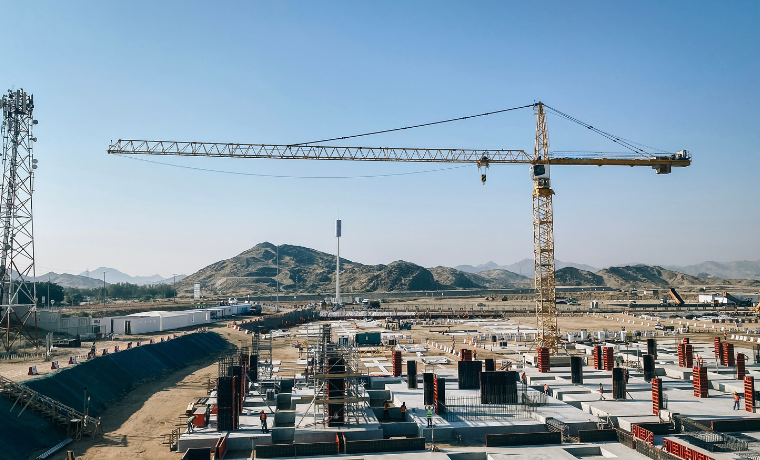
There also are serious, slower-moving threats. Climate presents significant risk, not only to workers themselves, but also to timely project completion. Workers building these data centers face grueling conditions, including severe heat and humidity. Construction workers are particularly vulnerable to excessive heat, which can cause heat exhaustion, kidney damage, and potentially fatal heatstroke. The International Labour Organization estimates that 83.6 percent of workers in the Arab States are exposed to excessive heat. The dangers are already well documented in the Gulf, where heat exposure became a defining human rights issue during Qatar’s construction boom ahead of the 2022 World Cup.
Saudi Arabia prohibits outdoor work in direct sunlight from noon to 3 p.m. between June 15 and September 15, but these restrictions leave substantial gaps. Research cited by Human Rights Watch (HRW) found some of the highest heat intensity occurs between 9 a.m. and noon —before the ban begins.
Moreover, there are well-documented accounts describing forced labor of migrant construction workers in the Gulf. Most of these construction workers in the Gulf migrate from South Asia. They are forced to pay their own recruiting fees, often the equivalent of year’s wages. In order to pay these fees, they typically pay lenders exorbitant annual interest rates, often of up to 50%. This puts the workers into debt bondage, a form of modern slavery in which workers are forced to work to pay back this onerous debt. This exploitation of migrant workers could expose the companies involved to legal liability in the US and EU.
While Saudi Arabia passed a Labor Reform Initiative in 2021, persistent loopholes allow employers to continue imposing restrictions on workers. Reports suggest that employers use false criminal charges to punish workers trying to leave abusive employment, that access to justice remains limited, and that workers face significant barriers to reporting rights violations. These practices are increasingly in the spotlight as Saudi Arabia prepares to host the 2034 World Cup.
As the US government asserts its commitment to fighting forced labor, lawsuits brought under the Trafficking Victims Protection Reauthorization Act have increased in number each year. The Act creates criminal and civil liability for companies that knowingly benefit from participation in a venture that involved forced labor. Because courts are still debating the law’s scope, the legal risk doesn’t just threaten tech firms; it also raises the specter of liability for the legion of Western financial institutions channeling and supplying the equity and credit. Liability risks also exist within the EU. The Corporate Sustainability Due Diligence Directive allows national regulators to fine companies up to 3 percent of their worldwide net turnover for the most serious violations, and affected parties can demand civil compensation for damages under national law. A related reporting law directs EU member nations to set penalties that are “effective, proportionate, and dissuasive.” Germany allows fines up to 5 percent of a company’s annual revenue in some cases. [RJB1]
HUMAIN has hired Goldman Sachs to raise at least $5.33 billion from private credit and equity sources. In parallel, Blackstone announced a $3 billion strategic partnership to develop and manage the Saudi hyperscale infrastructure alongside HUMAIN and AirTrunk, the dominant Asian and Middle Eastern AI infrastructure platform backed by four Blackstone funds in partnership with the Canada Pension Plan Investment Board.
As for Together AI, it has attracted venture capital from (among others) Kleiner Perkins, Coatue Management, Lux Capital, General Catalyst, Salesforce Ventures, and Nvidia’s venture arm, as well as Saudi Arabia’s Aramco Ventures, and the private equity firm Vista Equity Partners. Any of these financiers could face exposure if underlying labor or security risks materialize.
The HUMAIN-Together AI collaboration is just one of the many deals reshaping the geography of global AI infrastructure. But the challenges driving US tech companies to Saudi Arabia don’t disappear at the border. They will likely resurface in the form of geopolitical instability, labor exploitation, and potentially damaging reputational and legal fallout. These are material concerns for investors, regardless of whether one uses a framework of double materiality or strict financial materiality. Given the broader US financial system’s increasing exposure to AI companies, investors should demand the same labor and security due diligence they expect at home before a lawsuit, labor scandal, or missile strike forces a reckoning.
Regulators in the US and EU should close the gap between disclosure and enforcement on social and environmental impacts. Companies should ensure safe labor conditions and protect themselves against trafficking. Investors and lenders should use all the tools of stewardship to encourage the companies they finance to guard against material social and environmental risks. Moving offshore should no longer be a way of moving beyond the reach of the law.
 Technology & Democracy
 Values-Based Investing
 Global Labor
Related
See all