Forced Labor Goes to the International Trade Commission: The Nekkanti Shrimp Case
November 3, 2026
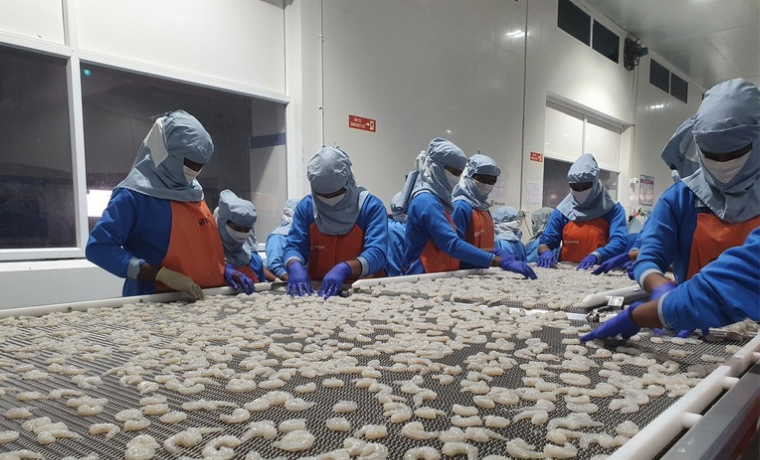
Image courtesy of Corporate Accountability Lab from their report Hidden Harvest, March 2024
On October 28, 2026, two US shrimping companies asked the US International Trade Commission (ITC) to block imports of shrimp from an Indian producer, Nekkanti Sea Foods, arguing that Nekkanti’s use of forced labor constitutes unfair competition with the US companies. This case presents a critical opportunity to establish a novel legal pathway to keep goods made with forced labor out of the US and thereby penalize the companies that sell them. By involving downstream retailers, the case also amplifies the risk to companies that fail to address the root causes of forced labor across their supply chains.
The complaint was filed by Versaggi Shrimp and W&W Dock, represented by Corporate Accountability Lab (CAL) and Picard, Kentz & Rowe. The complainants allege that Nekkanti’s low prices depend on using forced labor, and that those prices undercut domestic shrimpers who are bound by US labor law standards and do not use forced labor. And they brought the case not only against Nekkanti, but also its wholesaler and three downstream grocery chains: Aldi, Meijer and Ahold Delhaize, which operate Food Lion, Giant, Hannaford, and Stop & Shop among other brands. Complainants ask the Commission to issue an exclusion order, which would bar Nekkanti’s shrimp from entering the US, and cease-and-desist orders to prevent downstream retailers from selling it.
Deplorable conditions for shrimp processors in India
Years of research and reporting detail the deplorable conditions of workers in the shrimp supply chain in India. In 2024, CAL documented the conditions of a largely female workforce in Andhra Pradesh, India, including at two of Nekkanti’s facilities. CAL’s findings were corroborated by the Associated Press, the Outlaw Ocean Project, and CNN. Many of the workers are migrants from other Indian states, and many are members of the Dalit community or the Adivasi tribe, two groups that face social and economic marginalization in Indian society, leaving them especially vulnerable. The complaint alleges that workers live in guarded company hostels and are subject to severe restrictions on their movement—some workers face strict curfews and monitoring and may leave their hostels only once a month. Many workers report not being paid for overtime, having a share of their wages taken by third-party contractors, and lacking contracts. Migrant workers often arrive with debt to pay travel and recruitment costs, do not speak the local language, and are isolated.
This evidence strongly suggests workers are in situations of forced labor. The US Department of State reported “indicators of forced labor” in some Andhra Pradesh shrimp facilities in its 2024 Trafficking in Persons Report. The Department of Labor also added Indian shrimp to its 2024 List of Goods Produced by Child Labor or Forced Labor, specifically noting Andhra Pradesh worksites. The evidence also aligns with several of the International Labor Organization’s indicators of forced labor, especially abuse of vulnerability, restriction of movement, withholding of wages, excessive working hours, debt bondage, and abusive working and living conditions.
The impact on US shrimpers
There is also significant evidence of impact on US shrimpers, though causation may be difficult to prove. According to the Southern Shrimp Alliance, a domestic industry trade group that is supporting the Claimants, low Indian shrimp prices have contributed to declining prices for American shrimp in the US market. The US warmwater shrimp industry lost nearly half of its value between 2021 and 2024, and the number of vessels permitted to shrimp in US federal waters has fallen by 75 percent.
Fighting forced labor with a different tool
Efforts to prevent the importing of goods made with forced labor typically involve petitions to Customs and Border Patrol (CBP), which can block imports under Section 307 of the Tariff Act of 1930. The complainants took a different route, bringing a case under Section 337 of the Tariff Act, which gives the ITC authority to prevent the import of goods made through unfair acts or means of competition if the imports harm or threaten to harm a US industry. Usually, Section 337 complaints are about intellectual property disputes. Here, the complainants argue that forced labor is the unfair act; they must prove that Nekkanti uses forced labor and that doing so harms US shrimpers.
While the evidence appears strong, this would be the first time the ITC has recognized forced labor as a relevant example of unfair competition under this provision of the law. The complainants argue that legislative history and prior legal decisions suggest unfair methods should be construed broadly. Complainants assert that importation of forced-labor goods already violates Section 307 of the same law, which demonstrates that the practice is unfair.
This is not the first suit seeking another path to ban the import of goods made with forced labor. International Rights Advocates challenged CBP’s failure to act on its petitions to ban the import of cocoa from Côte d’Ivoire, asking the Court of International Trade to order CBP to issue a Withhold Release Order. The Federal Circuit affirmed the suit’s dismissal in June, holding that the advocacy group lacked standing to bring the case. Here, in contrast, the complainants are US shrimpers who allege direct harm from competing goods made with forced labor.
The Trump administration’s forced labor push
The complaint also aligns with the Trump administration’s stated commitment to keeping goods made with forced labor out of the US market. In July, the US Trade Representative (USTR) imposed tariffs of 10 percent to 12.5 percent on more than sixty economies, including India, for failing to ban, or effectively enforce a ban on, imports of goods made with forced labor. Those tariffs are being challenged before the Court of International Trade. Still, USTR framed the action as addressing an unfair burden on US workers and companies which maintain higher labor standards and therefore cannot compete on price with goods made with forced labor.
As I wrote in a previous QuickTake for the NYU Stern Center for Business and Human Rights, there are reasons to question how much those tariffs will accomplish, including because they penalize countries for allowing the import of goods made with forced labor but fail to address forced labor in a country’s domestic production and exports. India’s shrimp industry is a case in point: while India was placed in the lower 10 percent tier after adopting its own import ban, the tariffs do nothing to address conditions in domestic shrimp processing plants. This case targets that domestic production and the companies that allegedly failed to address structural drivers of forced labor, including reliance on migrant labor and a highly marginalized workforce.
The potential impact on India’s shrimp industry
If the Commission takes up the case and issues an exclusion order, that could have significant effects on the shrimping industry in India. The US is one of the world’s two largest markets for shrimp, so barring companies from accessing that market would create a strong incentive to address unethical labor practices.
The ITC Commissioners first have to decide whether they will institute, or accept, the case. The question will be open for public comment, and the Commissioners have thirty days to decide whether to open an investigation and instruct an administrative law judge to proceed with the case. The Commissioners’ ultimate decision will determine not only whether this case proceeds, but also whether the ITC sees forced labor as part of its mandate.
 Global Labor
Related
See all