Responsible Copper and Cobalt from Small-Scale Mines in the DRC: Now or Never
November 21, 2026
For seven years, I have asked upstream, midstream, and downstream companies, government representatives, and academic colleagues the same question: will you share responsibility for improving conditions in artisanal and small-scale mining (ASM) in the Democratic Republic of the Congo (DRC), so that critical minerals like copper and cobalt create safe and decent jobs for miners?
The way forward has existed for a long time. My Mutoshi case study lays out a detailed blueprint of how informal mines can be transformed into safe workplaces. What was missing was the will. Companies found it convenient to treat ASM as outside the scope of their sourcing responsibility.
That is changing. The industry’s stance is becoming less defensive, and the conditions for progress are better than they have ever been. Let’s take advantage of the moment without delay.
Why now
First, downstream companies are interested again. More of them are asking how they can contribute to formalizing ASM. We may have reached a tipping point: the plausible deniability that artisanal cobalt is not part of their supply chains is wearing thin. An estimated 15 to 30 percent of DRC cobalt comes from artisanal mines, and that material meets output from large-scale mines at several points along the way. Acknowledging this gets us to the starting line.
Second, Entreprise Générale du Cobalt (EGC), the Congolese state company through which all artisanal cobalt must now be sold, is up and running. It is currently seeking input on how to implement its Responsible Sourcing Standard and is looking for implementation partners. Some trading companies have already signaled support, and Mercuria’s commitment at Kasulo is one example. There is no need to wait for the standard to be finalized. The priority is to start, and to make sure that no one dies and no children are present on pilot sites.
Third, existing initiatives might be open to collaborating and building on each other. Deutsche Gesellschaft für Internationale Zusammenarbeit’s Cobalt for Development and the Fair Cobalt Alliance could pool resources to support a second proof-of-concept pilot project at an EGC-supported mine site.
What it takes
I see four basic requirements.
A neutral convening body. Someone has to support EGC in bringing the parties to the table, including processors, traders, refiners, and downstream companies. I would begin with a core group that has direct stakes in a specific site, and then invite downstream companies to join around a concrete plan.
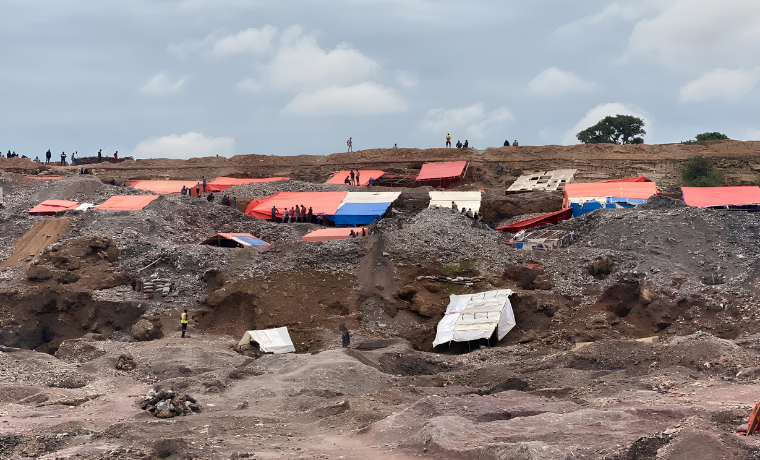
The right mine site. The ideal site is one where interests converge and where both copper and cobalt can be extracted. Producing both metals evens out the effect of cobalt price swings, because copper revenue can compensate when cobalt falls. That makes income steadier for miners and sourcing commitments more realistic for buyers. The site also needs to meet other conditions: shallow reserves suitable for open-pit mining, a cooperative willing to work on formalization, and ideally a location where mining can be separated from residential areas, so that dust and truck traffic do not put residents at risk.
A baseline study. Before anything changes, the site’s challenges need to be mapped carefully, above all mining accidents and child labor. Methodologically, this step is critical: only with baseline data can progress be measured over time and impact be demonstrated with evidence. Without it, even real improvements remain anecdotal. The study should be discussed directly with the cooperative, so that capacity is built from the start and ownership can eventually transfer to it. The core group can then develop a plan of action to address the findings and invite additional companies to support it.
Early downstream engagement. Downstream companies may prefer to wait until a site meets minimum standards before making sourcing commitments. But they cannot watch from the sidelines until then. Their support for transforming informal sites needs to begin earlier, while the work of reaching those standards is still under way.
The window is open
Conditions at a first site will not be perfect, and they do not need to be. The measure of success is direction: more miners working in open pits, and therefore fewer accidents as a result, more women directly involved in extraction, fewer children on site, and a cooperative that increasingly runs the project itself. As I have written before, getting comfortable with the uncomfortable is part of the work.
For years, despite the success of the Mutoshi pilot, key players in the copper and cobalt supply chain doubted that formalization could work at all. Now the question is who will move first. EGC has declared its objective to mainstream ASM formalization, Mutoshi shows how it can be done, and interested companies are stepping forward. What remains is for a few of them to act together, and soon.
 Global Labor
Related
See all